Biotech Strategy Blog

Commentary on Science, Innovation & New Products with a focus on Oncology, Hematology & Immunotherapy

Posts by MaverickNY

For years, the script has seemed obvious; if inhibiting an oncogene can hold the line, then degrading it altogether ought to be better.

After all, why merely silence the villain when you can remove them from the stage?

Yet cancer biology is rarely so obliging.

Sometimes the boldest move in drug development is not a triumph of logic, but the beginning of a more unsettling question…

To continue reading our latest highlights on oncology new product development including commentary and analysis BSB subscribers can log-in or you can click to access the content.

This content is restricted to subscribers

Source: The New York Public Library

In the first of our annual preview series for AACR 2026 in San Diego next month, we’re highlighting what was previously considered an ‘emerging area’ of cancer research.

It is now, in my view, an exploding one with a myriad of different compounds rapidly coming to the fore.

While not all of these will succeed, there are some available clues or breadcrumbs if you like, which we can follow to help determine which ones may struggle, while others are more likely to move forward in the clinic.

Take a quick guess before you check out the actual reveal…

To continue reading our latest highlights on oncology new product development including commentary and analysis BSB subscribers can log-in or you can click to access the content.

This content is restricted to subscribers

There are moments in markets, as in history, when enthusiasm swells just as the omens begin to gather.

Colloseum, Rome – one rainy day in time

CytomX’s latest colorectal cancer update, released the day after the Ides of March, has something of this quality about it.

At first glance the data offer exactly the kind of signal investors want to see.

At second glance they suggest a much more complicated story, one in which the opportunity may be narrower than advertised, the safety less settled than the presentation implies, and the unanswered questions rather more important than the headline…

To continue reading our latest highlights on oncology new product development including commentary and analysis BSB subscribers can log-in or you can click to access the content.

This content is restricted to subscribers

Source: Kidneys; a drawing by Europeana on Unsplash

In the final part of our mini-series from ASCO GU on strategic analyses, we move on to renal cell carcinoma (RCC), where a critical look at the data reveals several new potential high impact areas, as well as novel targets to watch out for.

These may be reshaping the evolving treatment landscape in a quiet way.

It won’t be all rose tinted glasses though because while RCC is moving into their next chapter, the hard questions are just starting to emerge…

To continue reading our latest highlights on oncology new product development including commentary and analysis BSB subscribers can log-in or you can click to access the content.

This content is restricted to subscribers

Destroying KRAS is not as easy as it looks

Most of the KRAS field is still refining the same basic ideas – block the pathway harder, longer, or more selectively.

We identified no less than seven early stage programmes, which are asking very different questions.

What came next was a surprisingly diverse set of answers to a problem most companies are still struggling to frame properly.

Some are elegant. Some are counterintuitive.

And at least one asks whether everything the field has assumed about pathway inhibition might actually be backwards…

To continue reading our latest highlights on oncology new product development including commentary and analysis BSB subscribers can log-in or you can click to access the content.

This content is restricted to subscribers

In looking at the new developments in urothelial carcinomas presented at ASCO GU in San Francisco last week, the biggest risk facing novel bladder cancer programmes right now is strategic rather than clinical.

Bladder cancer

The field has clearly been moving of late.

Meanwhile a number of molecules currently in phase 2 development could soon reach phase 3, only to find the control arm has changed, the endpoints have shifted, and the patients they’ll enroll may look nothing like the population the drug was originally intended for.

Loss of relevancy is a real threat in this kind of situation.

Here’s what you need to know…

To continue reading our latest highlights on oncology new product development including commentary and analysis BSB subscribers can log-in or you can click to access the content.

This content is restricted to subscribers

Last week we wrote about emerging trends in hematologic malignancies from the ASH25 meeting, which caused quite a stir in my inbox. In the main, most people liked this format and the most common question was ‘Can you repeat this for ASCO GU please?’

San Francisco

Sure we can!

There are three of analyses coming out this week from the data presented in San Francisco on prostate, bladder, and renal cell carcinomas.

To be clear, they come out quite differently because each is starting from a different baseline and set of circumstances on which to build from.

We’re going to start with the developments in advanced prostate cancer

To continue reading our latest highlights on oncology new product development including commentary and analysis BSB subscribers can log-in or you can click to access the content.

This content is restricted to subscribers

This is a story about three PD1×CTLA4 bispecific antibodies, with three engineering philosophies, three very different safety stories, and important development lessons hiding in the details…
In our latest analysis we asked a provocative question:

What can lorigerlimab, volrustomig, and cadonilimab tell us about the design choices shaping antibody development?

To continue reading our latest highlights on oncology new product development including commentary and analysis BSB subscribers can log-in or you can click to access the content.

This content is restricted to subscribers

There is a peculiar irony to how cancer drug development works. Imagine decisions shaping billion dollar pipelines a decade from now tend to be made in the least glamorous corners of the world’s biggest conferences.

Cancer cells        Source: Dr. Cecil Fox, NCI

While the late-breaking and phase 3 trial readouts tend to command centre stage, the early signals worth paying attention to.

These include biology hunches, proof-of-concept datasets, even creative ideas too nascent for an oral slot, which often appear quietly on laminated boards in vast, cold hangars.

If you want to understand where hematology/oncology is heading then this is a good place to start to learn about five emerging trends in the field we’ve identified…

To continue reading our latest highlights on oncology new product development including commentary and analysis BSB subscribers can log-in or you can click to access the content.

This content is restricted to subscribers

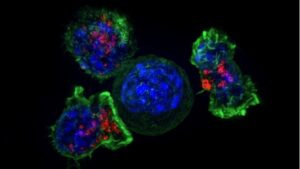
Killer T Cells surround a cancer cell Source: NIH

In the race for BCMA CAR-T dominance, we’ve long accepted a grim trade-off – to get industry leading response rates, you have to accept the risk of delayed movement and neurocognitive toxicities (MNTs).

Recent data from several groups are finally converging on why some constructs trigger these delayed events while others don’t.

The findings suggest the early belief that these issues were a result of higher expansion was likely off the mark…

To continue reading our latest highlights on oncology new product development including commentary and analysis BSB subscribers can log-in or you can click to access the content.

This content is restricted to subscribers

error: Content is protected !!