Biotech Strategy Blog

Commentary on Science, Innovation & New Products with a focus on Oncology, Hematology & Immunotherapy

Posts tagged ‘Boehringer’

Can we scale new heights with next generation anti-cancer agents?

One of the fascinating things about ASCO is how early new product development readouts outside of ‘hot’ names (or stock tickers) can often be ignored, forgotten, or simply dismissed as me-toos with seemingly comparable data.

The thing is, two people can look at a mountain and see it differently, much like five blindfolded people might describe various aspects of an elephant based on their perceptions of what’s in front of them – imagine what a tail versus a trunk or ear might produce, for example.

This is also particularly true with targeted therapies, which are undergoing something of a renaissance of late.

In this post, we look at five targets (and tumour types) where we are seeing some solid progress either with single agent therapy or with combination approaches, some of which – be warned – are rather controversial…

To continue reading our latest discussion on oncology new product development plus commentary and analysis BSB subscribers can log-in or you can click to access the content.

This content is restricted to subscribers

This year AACR is showcasing quite a few early approaches emerging from company pipelines on the KRAS front, including numerous upstream (pan SOS:RAS) and downstream or even cross-stream agents, which may potentially be combined down the road to improve patient outcomes beyond what we see now with selective KRAS inhibitors.

In this review we highlight five key development areas, which have emerged from the meeting so far and give us glimpses into where the puck is heading next…

BSB subscribers can read our latest conference coverage from AACR plus commentary and analysis – you can either log-in or click to access.

This content is restricted to subscribers

To simply say, “it’s complicated!” is a often bit of an understatement in cancer research.

Imagine any advanced cancer in the refractory setting might have multiple changes and defects driving oncogenic activity, which makes targeting just one or even two of them somewhat limiting in terms of the potential impact on outcomes.

Then there’s the whole separate debate of which approach to a given target is the best one – a small molecule degrader or an inhibitor or an antibody?


The best way to tackle these issues is to develop a detailed roadmap with various key landmarks identified, plus flags highlighting areas for further investigation.

Perhaps an underrated aspect of oncology research is the increasing use of chemical probes (degraders or small molecules) to explore the underlying biology in order to understand what needs to be done next in the form of resistance mechanisms or synergies, for example.

The findings generated from this research could then lead to the development of next generation pipeline agents or suggest novel combination approaches to evaluate, which may not have been obvious at first sight.

In this latest post, we take a look at various examples using protein degraders and small molecules though the lens of select patient populations, various tumour targets, and even mechanisms of resistance…

To learn more about our ongoing post AACR21 meeting analysis and expert interviews to get a heads up on key oncology commentary and insights, subscribers can log-in or you can click to gain access to BSB Premium Content.

This content is restricted to subscribers

It’s a good time to take stock of an early but important niche where the basic concept is the hijacking of the natural ubiquitin-proteasome (waste disposal) system for protein degradation therapeutics.

Traditional targeted therapies involve a small molecule or an antibody (in monoclonal or bispecific format) to inhibit an oncogenic target thereby shutting down the activity of the tumour, at least for a while.

Getting to the centre of things

What if we could find a way to biologically destroy oncogenic proteins instead – especially those which are hard to reach in normal circumstances such as protein-protein interactions?

The inherent potential for this concept would extend what we could do in terms of the proteome, but can it be done in people?

We have, after all, seen the selective estrogen receptor degraders (SERDs) evolve with one drug approved and several companies developing third generation versions in early stage clinical trials, so why not other targets too?

The simple truth of the matter is this elegant idea – while simple in theory – is technically quite challenging involving quite different obstacles from what we have seen with TKIs and antibodies.

Nevertheless, the difficulty has not fazed companies from trying and in looking at the broad landscape, we found 24 companies actively involved in protein degradation research in a multitude of targets and cancers. These span publicly traded biotechs, privately held companies, and of course, big Pharma.

Who are they and what can we learn from them in order to anticipate some of the issues to be addressed?

To learn more about the protein degrader landscape and get a heads up on our latest oncology insights, subscribers can log-in or you can click to gain access to BSB Premium Content.

This content is restricted to subscribers

Continuing our ASCO20 coverage with another Preview in the pre-meeting series, we turn our attention to a particular modality of keen interest to many of our readers.

In this latest article, we highlight ten areas within the niche and include an array of companies, both big and small, across Pharma and Biotechs.

Some of them have some nice data to share, others will be footnotes to the meeting, but who fits into what category and what can we learn from the abstracts upfront?

To find out more, we looked very carefully at the hints and nuance which inevitably grace the writer’s pen – it’s time to hone in on where are the flourishes and the crossings out this year?

To learn more from our oncology analysis and get a heads up on insights and commentary emerging from the ASCO meeting, subscribers can log-in or you can click to gain access to BSB Premium Content.

This content is restricted to subscribers

As we head into the AACR-NCI-EORTC Triple meeting in Boston this weekend, excitement is growing around a suite of RAS inhibitors in lung, colon and other cancers.

Charles River, Boston in October

Over the last couple of weeks we’ve received a bunch of questions from readers on several topics relating to this niche that I thought would be useful to spend some time on to set the scene ahead of the data dump expected on Monday and Tuesday.

Some people do like to try and simplify things thinking that it’s just a matter of adding in a checkpoint blocker or something else and boom! off we go… Except that we know from past experience with similar agents against different related targets that this won’t necessarily be the case and we look at some of the reasons why.

Yes I know folks are likely expecting too much in terms of efficacy, but we can put some framework and structure around the issues on which to build on, which are actually more than many may realise plus it could also be tumour and even patient dependent.

So here we go with a joint KRAS mailbag, together with a short expert interview with a view to highlighting some crucial roadblocks that are likely heading our way…

To learn more from our oncology coverage and get a heads up on insights from our latest thought leader interview, subscribers can log-in or you can click to gain access to BSB Premium Content.

This content is restricted to subscribers

We’re continuing our series following the development of novel cutting edge strategies targeting gamma delta (𝞬𝝳) T cells, with a look at the two approaches Puretech Health are pursuing based on the research of Dr George Miller (NYU Langone).

Data was presented at #AACR19 for a first-in-class immunotherapy targeting immune-suppressive delta 1 containing 𝞬𝝳 T cells and one targeting Galectin–9.

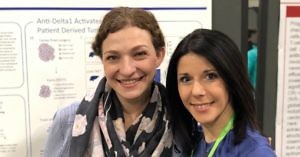
Drs Panchenko and Filipovic at their AACR19 poster

We recently spoke with Dr Aleksandra Filipovic, therapeutic lead for oncology at Puretech Health, she’s pictured right with Dr Tatyana Panchenko from NYU Langone at their AACR poster.

Dr Filiopovic told BSB that Puretech are looking for the next big IO breakthrough:

“We looked at this landscape and the massive amount of trials going on. We said ok, if we’re going to go into the space of immuno-oncology, what is it that we need to do differently in order to, upfront, try and ensure that we’re going after targets which could be the next PD–1. Our thinking went along the lines that we would really need to identify those next checkpoints, those next foundational modulators of the immune system.”

This is the first of two interviews from #AACR19 on novel strategies to target 𝞬𝝳 T cells, an emerging area that companies are looking at with both antibody and adoptive cellular therapy approaches. Do check out our previous mini-series if you missed it.

To learn more and get a heads up on our latest oncology insights and thought leader interviews, subscribers can log-in or you can click to gain access to BSB Premium Content.

This content is restricted to subscribers

error: Content is protected !!