Biotech Strategy Blog

Commentary on Science, Innovation & New Products with a focus on Oncology, Hematology & Immunotherapy

Posts tagged 𔃱L NSCLC’

Checkpoint Charlie, Berlin

Akeso Bio’s HARMONi-6 data look encouraging on the surface with a hazard ratio of 0.60 for median progression-free survival (mPFS). As a result, the media coverage has been predictably euphoric and positive.

This was a trial run in China and focused on squamous non-small cell lung cancer (NSCLC), and the very factors making it successful are precisely why the upcoming global HARMONi-3 readout from Summit Therapeutics is unlikely to replicate these results.

The devil, as always, is in the details, which should make investors and other companies active in this space nervous about what comes next.

In this post we take a much more bearish approach to the opportunities for ivonescimab, as we go through the emerging red and green flags…

To continue reading our latest highlights on oncology new product development including commentary and analysis BSB subscribers can log-in or you can click to access the content.

This content is restricted to subscribers

Competition in the PD(L)1 x VEGF bispecific niche is becoming increasingly scattered

For the second consecutive year, Summit Therapeutics will present key clinical data at the World Congress on Lung Cancer rather than ESMO, a pattern which may reflect ongoing challenges in positioning their ivonescimab program for regulatory success.

Other competitors including BioNTech and Instil Bio will also be in Barcelona, giving us an opportunity to see how this hyper crowded niche is beginning to shake out a little.

In this Preview of the meeting, we take a look at what to watch out for and offer some pointers and critique about what’s coming down the pike…

To continue reading our latest highlights on oncology new product development including commentary and analysis BSB subscribers can log-in or you can click to access the content.

This content is restricted to subscribers
It’s time to take five lung cancer trials, put them through their paces and explain why all may not be quite what it seems in terms of future success.

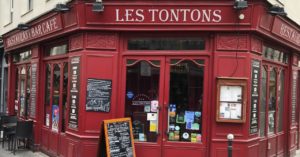
Paris street cafe

The long term impact is likely to be far greater than slapping tariffs on penguins.

In the rush to declare “impressive results” or “a game changer” some observers may well be missing the bigger picture…

To continue reading our latest highlights on oncology new product development including commentary and analysis BSB subscribers can log-in or you can click to access the content.

This content is restricted to subscribers

ESMO IO always seems a good place for finding tricky immunotherapy datasets and this year was no different with Mirati revealing their update adagrasib plus pembrolizumab data from the KRYSTAL 1 and 7 trials.

The KRAS G12C niche is not only becoming increasingly competitive, but also more controversial as time goes by.

The recently updated sotorasib data in 2L NSCLC caused some consternation and it seems the same is true for adagrasib, although in a quite different fashion.

Here we analyse the data and the clinical direction to critically assess the near to medium term opportunities, with some red and green flags to consider along the way…

To continue reading our latest cancer conference highlights on oncology new product development including expert commentary and analysis BSB subscribers can log-in or you can click to access the content.

This content is restricted to subscribers

With the increasing pipeline of novel targeted and IO agents emerging from company pipelines these days, one key question which often comes up is can we get rid of chemotherapy – even in the first line setting?

On the upside, many patients would likely prefer to avoid chemotherapy treatment where at all possible, but on the downside, most of these agents are now available cheaply as generics and switching in another therapy doesn’t mean the absence of any additional side effects, just different ones.

During the 2022–2023 time frame we are going to see a surge in IO-IO readouts from both phase 2 and 3 trials as the data begin to mature over time.



In our latest look at IO combination strategies, we take a look at one such approach and examine the pros and cons involved based on the data available…

BSB subscribers can read up on our ongoing oncology commentary and analysis – you can either log-in or click to access the back story behind the latest innovation.

This content is restricted to subscribers

Barcelona – It seems only in only four years we have gone from discussing the phase 1 osimertinib data in EGFRm lung cancer with one Boston expert to reviewing the survival data from the phase 3 study with another expert from the same city… how time flies!

Today was a crazy day with multiple different embargoes lifting at different times so to make things simpler we carved out three different tracks to make it easier for readers to focus and follow the stories they are most interested in.

The KRASG12C clinical trial readouts continue apace with a look at the new non-lung cancer data. That post already went live at 1.30am ET if you’re looking for that evolving story.  The main highlights post with a daily running live blog and multiple updates throughout the day can be found here.

Meanwhile this particular post will contain everything related to osimertinib and the FLAURA trial, as well as where we are on uncovering resistance mechanisms. To get started we have a new press release to look at as well as some independent expert commentary to put the data in context.

To learn more from our latest oncology conference insights and get a heads up on our latest ESMO Coverage, subscribers can log-in or you can click to gain access to BSB Premium Content.

This content is restricted to subscribers

AstraZeneca miss on OS in the phase 3 MYSTIC trial – what next?

Getting there… in 1L NSCLC

At one point we were posting almost quarterly updates on the runners and riders in the 1L NSCLC niche and what a roller coaster it has turned out to be!

There have been some successes, failures, and even mixed results so far, suggesting that there’s no room for complacency here.

Previously, AstraZeneca were the first to readout out on PFS in the MYSTIC trial and missed, meaning they had to go to the back of the queue and patiently await the OS data. Since then, we’ve seen several phase 3 trials from Merck, Genentech/Roche and BMS all readout without any real rhyme, reason or consistency between them.

Now AstraZeneca are back in the spotlight with a not altogether unexpected miss on median OS.

It’s easy for people to kick a dog when it’s down rather than take a moment to reflect on the deeper meaning – what does the result mean both for the company and other key players in this highly competitive landscape? What can we learn from this experience and other recent results?

To answer that, we put some insights and analysis together in our latest update on the space…

To learn more about our latest insights, subscribers can log-in or you can purchase access to BSB Premium Content…

This content is restricted to subscribers

At AACR last week we had the long awaited initial readouts for three key phase 3 studies in lung cancer, namely CheckMate–227, IMpower150, and KEYNOTE–189 in the same session on the same day.

This had me thinking about how it might end up being, “a killer and a chiller and a thriller when I get the (PD–1) gorilla in Manila,” with sincere apologies to Muhammed Ali and Dr Jean-Charles Soria for (mis)appropriating their past themes 😉

Chicago River Bridge at #AACR18

For those attending the event, you might well be forgiven for thinking from the first two adjectives that I’m referring to the weather, as it was certainly cold enough (!), or even the results this week from AstraZeneca’s unfortunately named ARCTIC study exploring the IO-IO combo of durvalumab plus tremelimumab in the third line setting with a miss in both PFS and OS endpoints.

In reality, we should be warmed and heartened to see three positive immunotheraopy trials appear at once and presented in the same session at the same meeting.  It isn’t always the case as regular attendees at ASCO well know.

When all is said and done, what do thought leaders specialising in lung cancer really think about the data that was presented in Chicago, and what were the convergence and discord on the various key issues under consideration?  There is, after all, a lot of subtlety and nuance to consider in 1L NSCLC.

To find out more, we interviewed not one, but four, lung cancer specialists in Chicago for their personal perspectives.  What they had to say as a group was both candid and absolutely fascinating, so it made sense to curate their insights around various key topics together into one detailed post for easy reading… 

To learn more and get a heads up on our latest thought leader interviews and oncology insights, subscribers can log-in or you can click to gain access to BSB Premium Content.

This content is restricted to subscribers

After yesterday’s notes on the exciting lung cancer clinical trials plenary, I received a bunch of questions from readers following yesterday’s analysis of the 1L NSCLC market.

This is a good opportunity to take some time out to answer some of them, as they highlight some important points worth discussing, clarifying and reviewing.

To learn more and get a heads up on our latest oncology insights, subscribers can log-in or you can click to gain access to BSB Premium Content.

This content is restricted to subscribers

Things are heating up rapidly in the 1L non-small cell lung cancer (NSCLC) space with the latest news that Merck’s pembrolizumab beat out chemotherapy as monotherapy in previously untreated stage 4 patients in KEYNOTE-042.

Is the path to success is a rocky road for some companies in 1L NSCLC?

BMS’s trial in this setting, CheckMate-026, previously failed to show any benefit for nivolumab over chemotherapy, so what gives?

There is no doubt that Merck have been on a roll in lung cancer of late with nary a false step with pembrolizumab thus far.  Is that down to luck or careful preparation?  Are there differences in the molecules or trial designs?

Here, we take a look at the two situations and continue our ongoing analysis as these results certainly offer a ‘tale of two cities’ perspective in the same indication.

To learn more and get a heads up on our latest oncology insights, subscribers can log-in or you can click to gain access to BSB Premium Content.

This content is restricted to subscribers

error: Content is protected !!