Biotech Strategy Blog

Commentary on Science, Innovation & New Products with a focus on Oncology, Hematology & Immunotherapy

Posts tagged ‘DLL3’

Rolling into Madrid!

One of the challenges we are starting to see more attention on is what happens in later lines of treatment for advanced solid tumours, regardless of whether prior therapy involved chemotherapy, immunotherapy, or hormonal therapies.

How can we provide new options for treatment of refractory disease and help more people live longer?

Finding active drugs with both a reasonable safety profile and demonstrable solid activity in a situation with more complexity in terms of the underlying biology coupled with a much higher tumour burden has long been a challenge for many oncologists and companies.

In previous years we saw how poorly checkpoint inhibitors did in this setting compared to using them upfront and while chemotherapy is very effective at shrinking tumours, the effects are rarely long lasting.

What’s next then?

One approach involves bispecific antibodies where the tumour cells and T cells are literally dragged into closer proximity, enabling the serial killers to do their job more effectively.  They worked rather nicely in blood cancers, so why not in solid tumours?

After nearly a decade of trying out many permutations of this approach, we are finally starting to see some light at the end of the tunnel with several different agents in diverse tumour types…

To continue reading our latest highlights on oncology new product development including commentary and analysis BSB subscribers can log-in or you can click to access the content.

This content is restricted to subscribers

Scaling the ramparts in Real Madrido

In our last ESMO23 Preview ahead of the live meeting starting on Friday, we highlight another eight targets to watch out for where there will be intriguing data dropping out from Madrid over the weekend.

More than just the data though, is consideration for the implications of the findings and how they can impact a particular tumour landscape.

One thing to note is just because a company highlights what they consider to be positive data doesn’t always mean it is actually so when you look carefully at the small print.

Not surprisingly there are a few examples of this genre at the forthcoming conference…

To continue reading our latest highlights on oncology new product development including commentary and analysis BSB subscribers can log-in or you can click to access the content.

This content is restricted to subscribers

Gardens by the Bay in Singapore

With the abstract titles now available for the World Congress in Lung Cancer (WCLC), it’s time to take a look at what we can expect for the meeting coming up in early September.

In our latest conference Preview, we have highlighted several education sessions to look at, as well as ten key oral presentations to watch out for…

To continue reading our latest highlights on oncology new product development including commentary and analysis, BSB subscribers can log-in or you can click to access the content.

This content is restricted to subscribers

Linie 30 Florisdorf, Vienna

With all the frequent attention on lung cancer of late – mostly on the most common form, non-small cell lung cancer – it’s easy to forget small cell lung cancer (SCLC) in the rush to highlight new developments.

It’s time to talk turkey about old and new agents in the quest to improve outcomes for people with this dismal disease.

The good news is there are also a raft of scientific developments emerging, which may potentially help us better identify discrete subsets and enable the matching of appropriate regimens to the underlying biology.

At the World Conference in Lung Cancer this week in Vienna we’ve been following the numerous trials (and tribulations!) of progress in this niche, with a look at several key readouts through the lens of a thoracic lung cancer specialist.

What does he have to say and where are things heading next for the field?

To find out more, check out the interview below…

To continue reading our latest discussion on oncology new product development plus commentary and analysis BSB subscribers can log-in or you can click to access the content.

This content is restricted to subscribers

New product development and early phase anti-cancer agents have been very much a focus on BSB (and PSB before it) since their inception.

It’s fascinating to realise one of the compounds selected for review in this article has its origins in a much one earlier trial with serious incidents we saw in a trial in novel volunteers with a different company and product and originally inspired the beginning of our scientific writing in 2006.

By an interesting quirk of history, the first time we wrote about PARP inhibition was in the same year and now it is one of the selections in the ASCO plenary today.  You can read more about the olaparib OlympiaD trial write-up here, proof that all successful products eventually started off in developmental therapeutics at some point in their early career!

In this latest review, we selected eight anti-cancer compounds currently undergoing phase 1/2 trials and put them through their paces… some are more positive than expected, some were downright disappointing, some were off to an encouraging start, others the count is out until we see more robust data.

How is the report card looking this year?  Some reflections and thoughts to consider…

To find out, BSB subscribers can read more on our perspectives regarding Developmental Therapeutics and various early stage compounds, subscribers can log-in or you can click to read our ongoing ASCO21 coverage.

This content is restricted to subscribers

Last October I posted two updates on small cell lung cancer (SCLC). One explored the broad SCLC landscape, while the second was a detailed analysis highlighting the red and green flags to watch out for in the Rova-T TRINITY study.

My sombre conclusion or prediction, if you will, was not particularly well received at that time:

“My sense is that the median PFS and OS in the allcomer ITT population will remain modest and in line with what we might expect from historical chemos in 3L SCLC.”

Dismal happenings are to be expected…

This morning AbbVie announced that they will not be filing for accelerated approval of Rova-T in 3L SCLC based on the interim analysis.  In other words my expectations for this trial were met, although there are many who will be very disappointed at the results.

What matters though is not just how disappointing topline results might be per se, but why they occurred, what we can do about it, and most importantly, where we go next.  There’s a lot more to this than might initially be obvious from the press release.

That’s what this new post is all about… first a post mortem, then the obstacles to be addressed, and finally, what we can look forward to in SCLC…

On a happier note: there may be some surprises ahead!

To learn more and get a heads up on our latest oncology insights, subscribers can log-in or you can click to gain access to BSB Premium Content.

This content is restricted to subscribers

Yesterday in part 1 (Link) of our latest mini-series, we looked at the SCLC landscape and some of the key background issues to think about.

This time around in part 2 we drill down focus more specifically on Rova-T, including physician and patient sentiments and in particular, what to watch out for with the upcoming phase 2 TRINITY readout.   There’s a lot to consider here so we’ve broken the analysis down to five key areas.

Mystic Meg is also back with her canny predictions – what does the crystal ball portend for Rova-T and the TRINITY trial?  Caveat: she’s been on a tear of late; this situation will not continue forever.

To learn more insights on this intriguing topic, subscribers can log-in or you can click to gain access to BSB Premium Content.

This content is restricted to subscribers

Many of the questions we received from BSB readers this month was a plea from several folks to answer numerous queries about small cell lung cancer (SCLC) and the anti-DLL3 ADC, Rova-T, in particular.

Of course I’m happy to oblige, but this was way too big a topic for inclusion in Friday’s mailbag.

Cornish Tin Mine

What makes a lot more sense here is a short two-part mini series where we look at the dismal landscape of the disease and then consider the red and green flags that arise from the Rova-T development.

With the interim results expected from the phase 2 TRINITY trial in 2H17, this is a timely moment to sit down and reflect on what to expect.

In the first part of the series, we walk through SCLC as a disease, including what is known and what to consider when contemplating a new therapy here.

In the second part tomorrow we will focus more specifically on Rova-T and what to watch out for.

So let’s rock and roll with a look at the SCLC landscape…

To learn more insights on this intriguing topic, subscribers can log-in or you can click to gain access to BSB Premium Content.

This content is restricted to subscribers

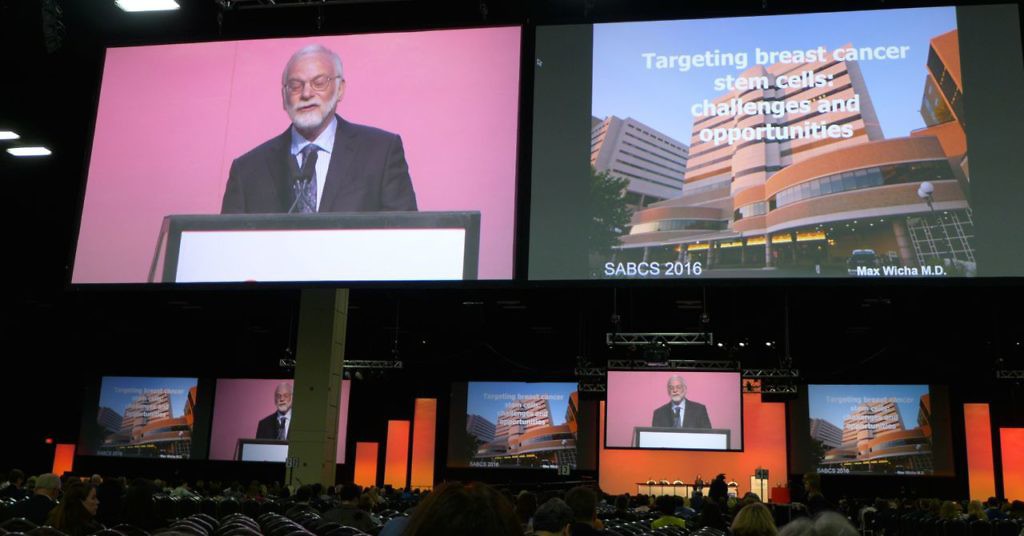
Dr Max Wicha is the 2016 recipient of the AACR Distinguished Lectureship in Breast Cancer Research. At the 2016 San Antonio Breast Cancer Symposium (SABCS16) he gave his award lecture, “Targeting Breast Cancer Stem Cells: Challenges and Opportunities.”

SABC16 Dr Max Wicha Award Lecture

As the AACR press release notes, “This lectureship recognizes an outstanding scientist whose work has inspired or has the potential to inspire new perspectives on the etiology, diagnosis, treatment or prevention of breast cancer.”

Dr Wicha is a pioneer in the field of cancer stem cells, and is Director Emeritus of the University of Michigan Comprenhensive Cancer Center and a co-founder of OncoMed Pharmaceuticals (NASDAQ: OMED).

Targeting cancer stem cells is an area I expect we will hear a lot more about, particularly in breast cancer. Dr Wicha kindly spoke to BSB after his award lecture, which was one of my highlights of SABCS16.

In case you missed it, do check out the post from the 2016 EORTC-NCI-AACR Molecular Targets Symposium in Munich that featured Dr Mina Bisell (Berkeley), who was a previous recipient of the AACR Distinguished Lectureship in Breast Cancer Research award in 2012 (Link.)

This is the fifth in our series of expert interviews from the 2016 San Antonio Breast Cancer Symposium.

Subscribers can login to read more

This content is restricted to subscribers

At the European Cancer Conference (ECC 2015) held in Vienna recently, a number of promising targets emerged along with new drugs in development in several different tumour types.  Not all of them were from big Pharma – some were from up and coming young biotechs that will be worth watching out for.

In this first part of our ‘New Drugs on the Horizon’ mini series, we chose four interesting and largely positive studies to highlight and discuss in-depth.

In the past, there were many negative trials to pick over and ponder why they didn’t quite pan out.  After all, it’s relatively easy to be an armchair critic and hindsight is a wonderful thing.

Picking only four from the many promising choices of trials presented this year available turned out to be quite hard given there were many that caught our attention – a bit like choosing only one of four out of the many schnaps to sample locally!

Today’s review looks at four very different drugs and approaches in early development from Pfizer, Stemcentrx and Ignyta – they include encouraging early data on both small molecule tyrosine kinase inhibitors (TKIs), as well as antibody drug conjugates (ADCs).

To learn more insights on this intriguing topic, subscribers can log-in or you can purchase access to BSB Premium Content. 

This content is restricted to subscribers

error: Content is protected !!